Pelagic
A living surface,
an oceanic expanse.
Microscopic life.
The presence of a vast terrain.
01 / Through time
Growth becomes a terrain.
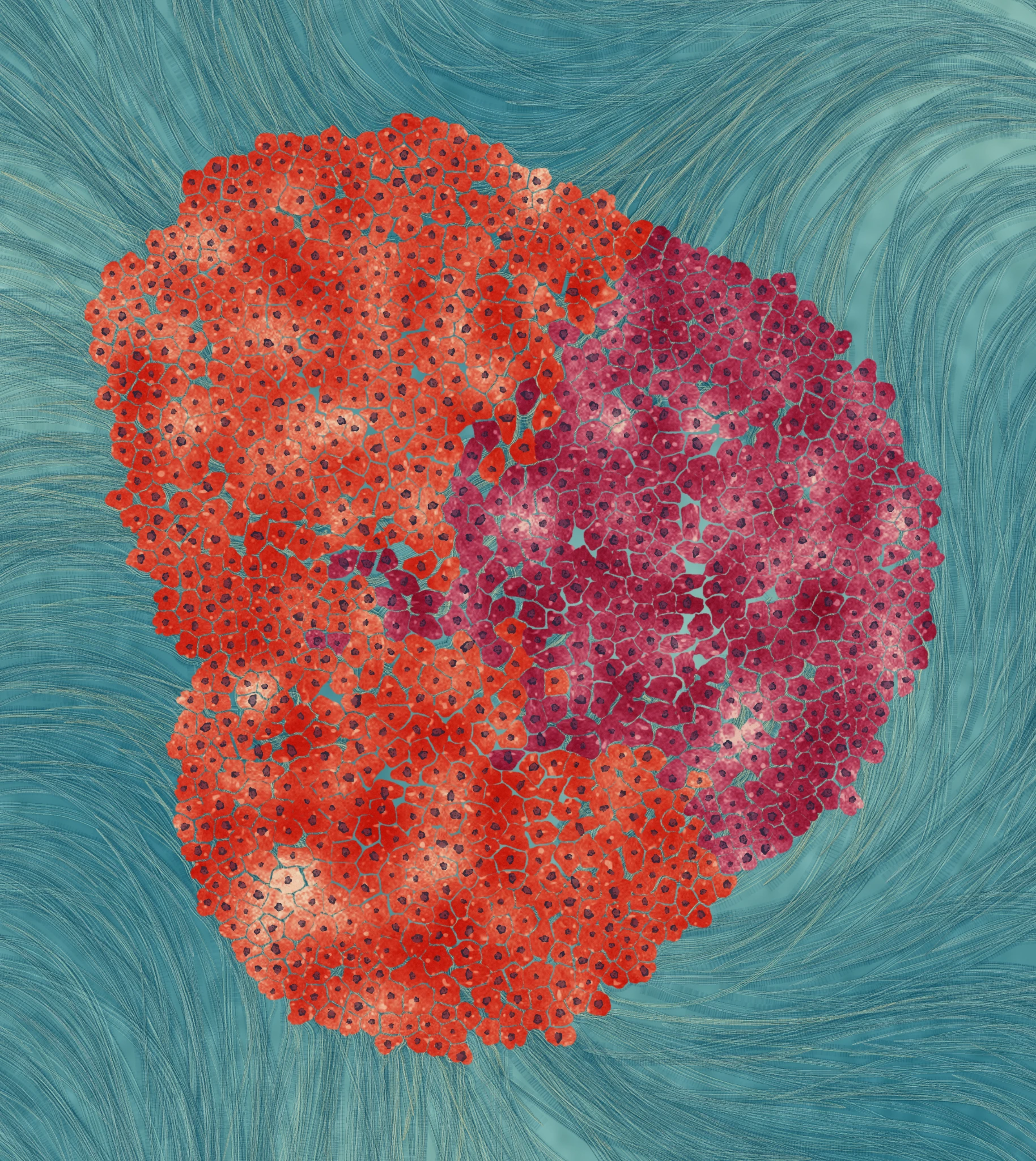
Fine cellular strands develop above a soft surface, while currents and compression reshape the material below.
Development into the encounter state, with interpolation between simulation steps for smooth motion.
Download recording ↓02 / Interpretation
Small lives,
sculptural forms.
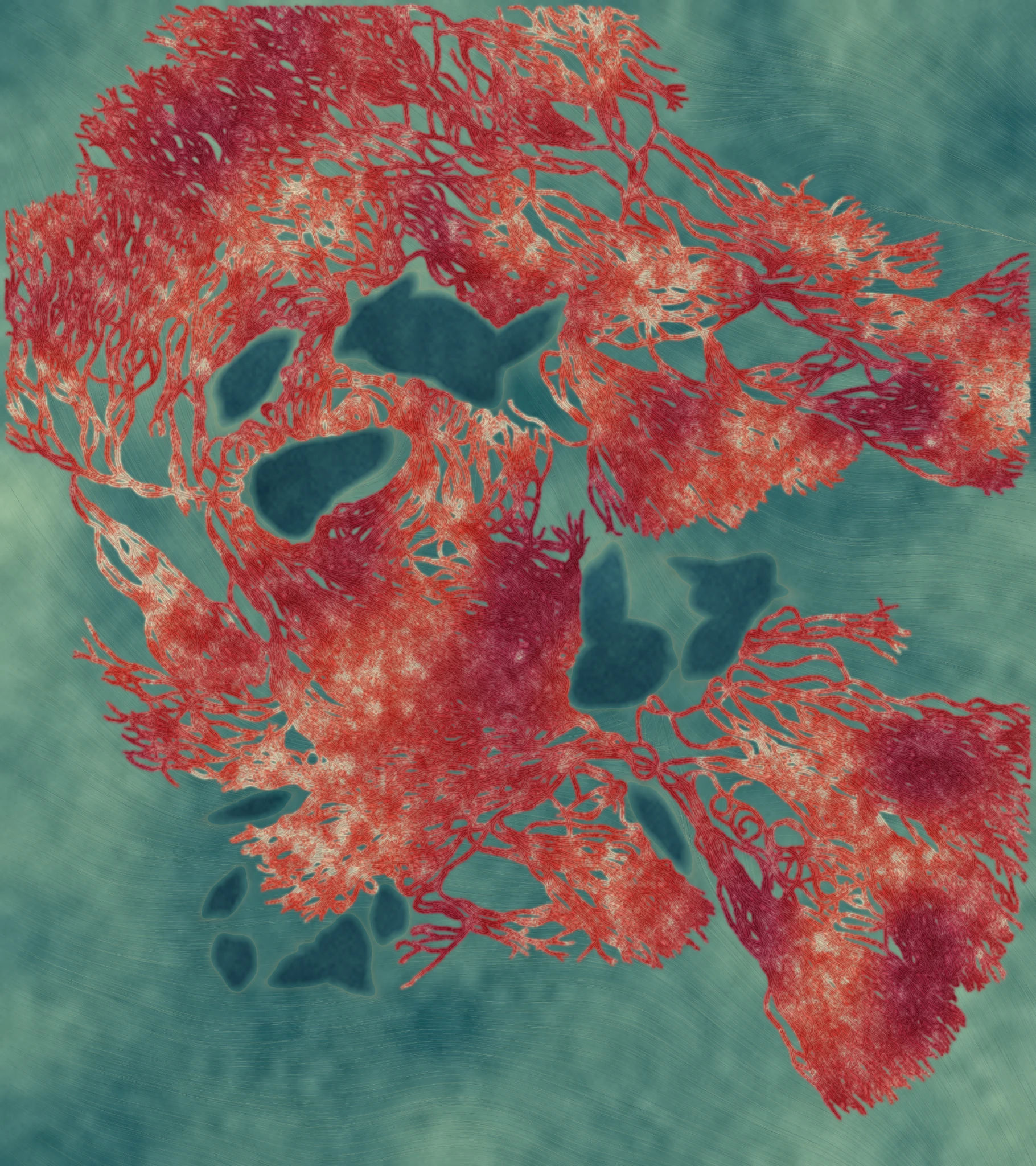
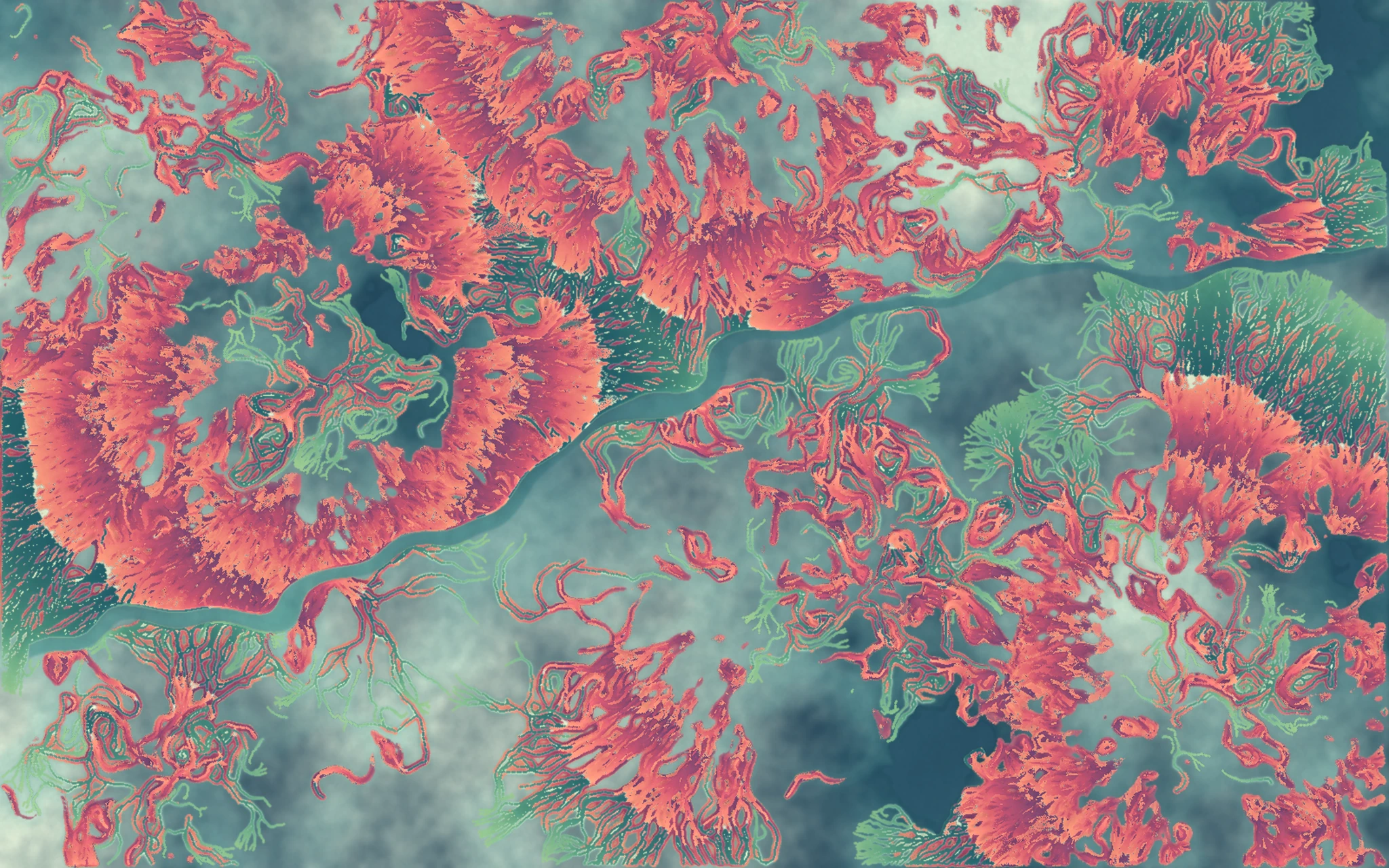
Pelagic follows a living surface as it grows, drifts and folds. Fine blue-green filaments trace pale ridges, gather into dense tangles and sweep around deep blue openings. The image holds two scales together: the delicacy of a microbial film and the sweep of an oceanic landscape.
Within Intelligence in Nature, Pelagic celebrates the sculptural force of microscopic life. Growth and secretion build a soft material that currents rearrange and compression folds. These small, local processes acquire the presence of a vast terrain, with fine branching and broad, rolling forms developing across the same surface.
03 / Process
How the work takes form.
Establish the moving surface
A Python artificial-life simulation begins with scattered microbial colonies on an uneven surface. It represents connected photosynthetic cells alongside smaller cells that consume released organic material. Moisture and nutrients vary across the environment, while changing currents transport resources, secretions and cells.
Let growth reshape the surface
Cells absorb resources, grow and divide; connected chains extend, branch and bend. The community secretes material that accumulates into a soft coating and changes local flow and cell movement. As this material builds up, it increases compression in a simplified elastic-film model, causing the surface to buckle into broad folds beneath the finer cellular strands.
Render the living relief
A separate renderer gives the cells, coating and underlying surface deep blue, teal, pale green and warm mineral tones. Simulated height supplies relief and shading, while accumulated material and nutrient availability influence colour. The encounter image frames a selected growth stage. The recording follows development into that state with the same material treatment, interpolating between simulation steps for smooth motion.
Companion study
Confluence
04 / Source
Open the work.
The cells, the currents, the folds.
Explore the code that brings them together.
Render the included selected state.
- model.py
- The living film
- render_pelagic.py
- The material and relief
- make_pelagic_video.py
- Development through time
Reproduce the work
Unzip the download and open a terminal inside Pelagic_Simulation.
Python 3.12; NumPy, SciPy and Pillow; a C++17 compiler (g++ or clang++). FFmpeg with libx264 for video. Windows uses WSL.
python -m pip install -r requirements.txt
python render_pelagic.py --width 1500 --out preview_images
The preview renders from a supplied state. The package includes all simulation and rendering code and both states; the optional reference JPEG is omitted. Full-resolution rendering needs several GB of memory. See the README for encounter framing and movie export.
What’s in the download
Simulation, C++ mechanics, renderer, encounter framing and film exporter; initial and selected states; numerical settings and recorded checks.
Instructions and numerical settings are included with the code.
Continue the exhibition