Inhabited Ground
Built, inhabited,
and renewed.
A shared surface.
A landscape shaped by its occupants.
01 / Through time
A landscape continually remade.
Builders lay down a living ground. Settlers occupy it, consume it and make room for growth to return.
A fixed viewpoint follows growth, settlement and recycling across the same landscape.
Download recording ↓02 / Interpretation
Life makes room
for life.
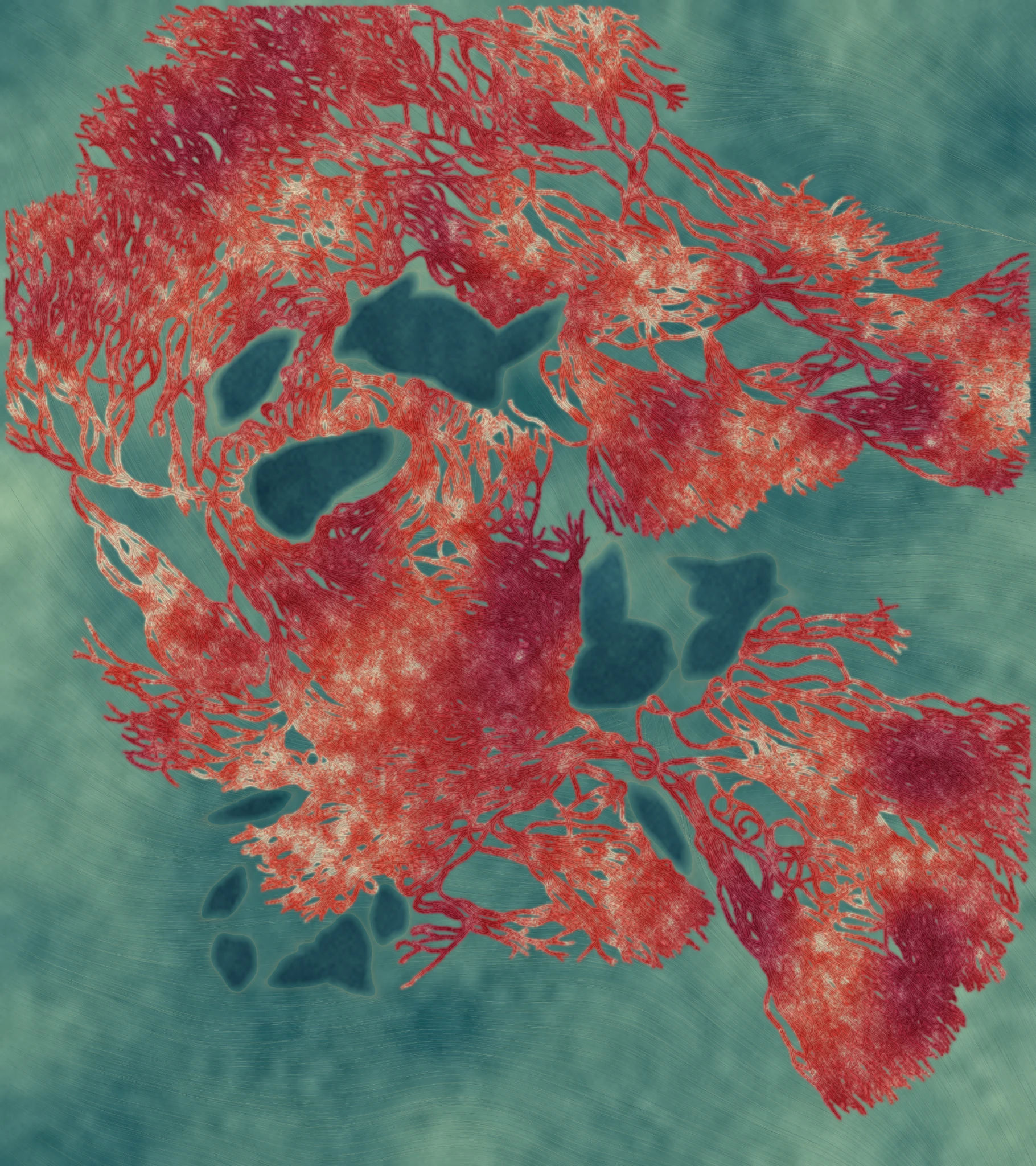
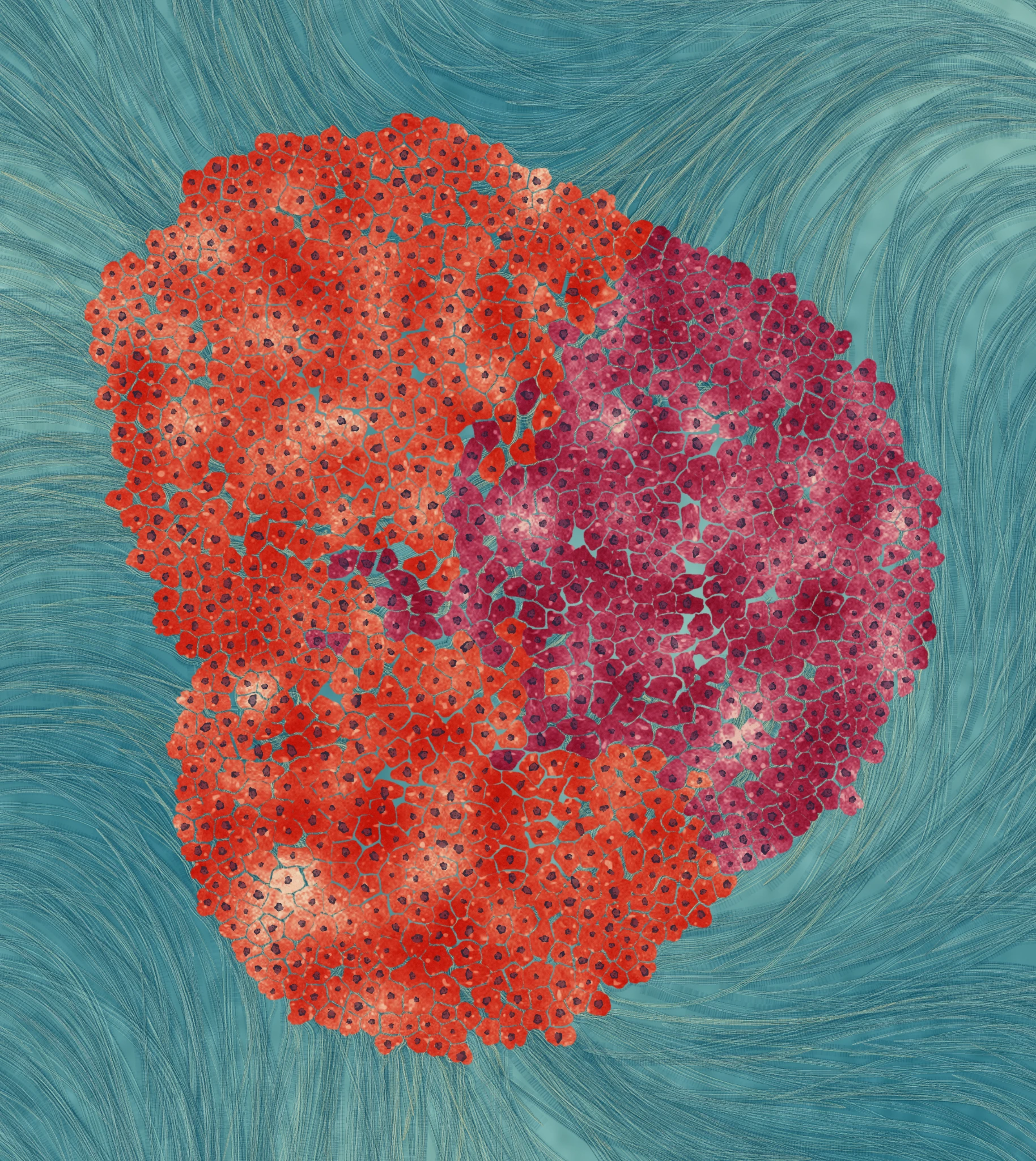
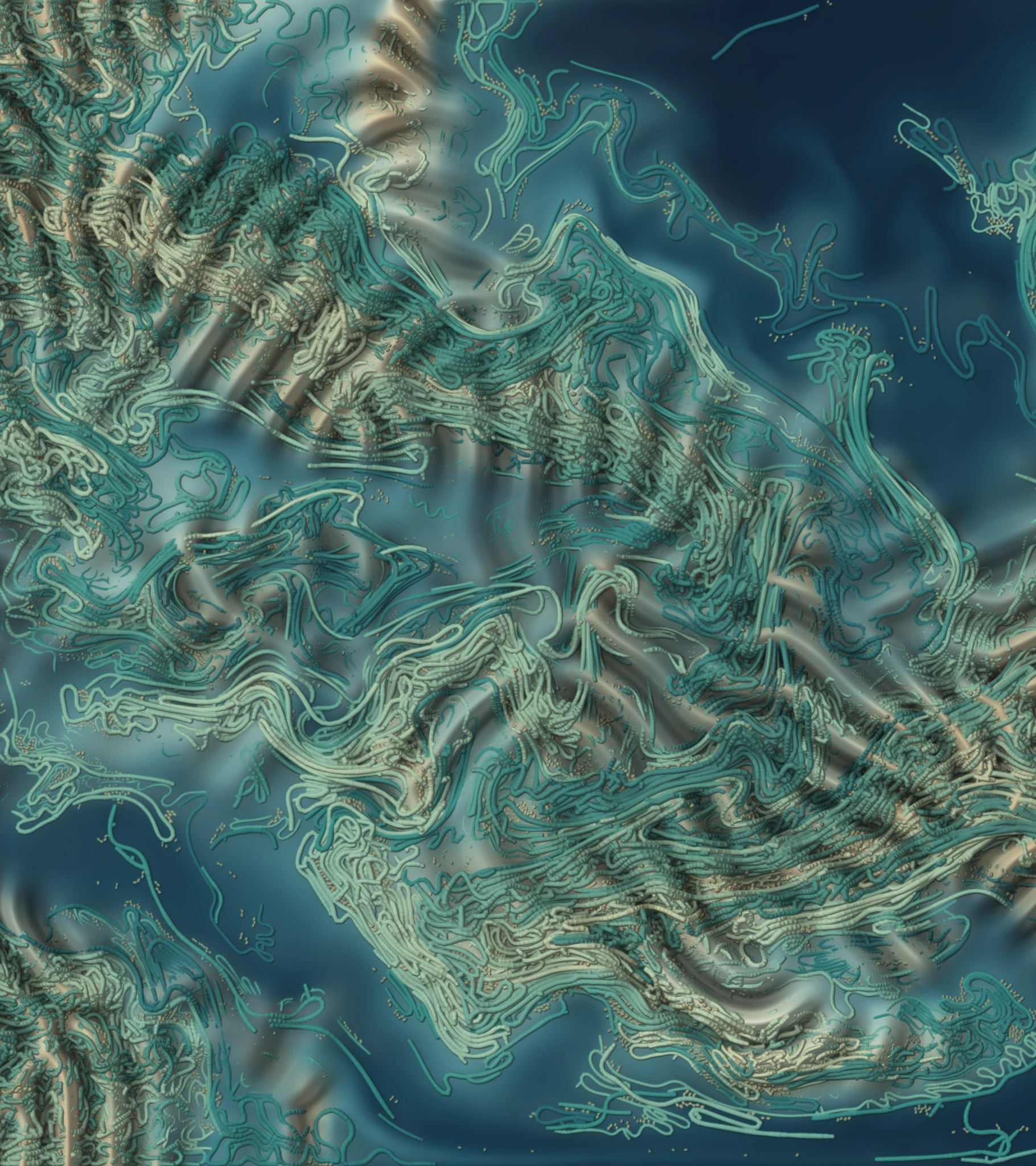
Inhabited Ground follows two communities building, occupying and renewing the same surface. Fine green branches spread around a winding channel, laying down a pale, porous material. Coral and rose colonies occupy this bed, gradually consuming it. Fresh green growth returns to altered patches, so young branches, densely inhabited areas and depleted openings coexist across the blue-green landscape.
Within Intelligence in Nature, the work celebrates how living things create conditions for further life. What one community builds becomes another’s habitat and food; what the second breaks down feeds the next wave of growth. The landscape acquires its richness through this repeated exchange—being constructed, inhabited and renewed by its occupants.
03 / Process
How the work takes form.
Establish the landscape
A Python artificial-life simulation begins with seven small builder colonies on a two-dimensional terrain. Nutrients and moisture vary across the surface, while a fixed channel and pools leave gaps that the organisms cannot occupy. The simulation tracks living occupants, their ages, available nutrients and accumulated material.
Let the communities transform their habitat
Builder tips extend and branch in response to nearby nutrients, moisture and crowding. They secrete material that spreads around their strands and persists after the builders die. A second population—the settlers—can establish only where sufficient material exists. Settlers consume this bed and return nutrients to their surroundings. New builder growth can then restart in vacated areas with a history of settler activity and enough available nutrients.
Render the layers of occupation
A separate renderer gives builders green and teal tones, settlers coral, rose and violet, and retained material a pale appearance. Colour varies with age and nutrient availability; material thickness contributes opacity and soft relief. The recording maintains a fixed viewpoint as the communities develop, showing new growth, settlement and recycling occurring in different parts of the same landscape.
04 / Source
Open the work.
The builders, the settlers, the ground.
Explore the code that brings them together.
Regenerate the ecology, recording and selected still.
- landscape.py
- The two communities
- make_film.py
- The development recording
- select_still.py
- The selected encounter
Reproduce the work
Unzip the download and open a terminal inside Inhabited_Ground_Source.
Python 3.12; NumPy, SciPy and Pillow; FFmpeg with libx264.
python -m pip install -r requirements.txt
python make_film.py --out output
python select_still.py --out output
This route computes the growth and exports the recording before selecting the encounter at step 480. It requires FFmpeg and takes longer than rendering a saved state. The original code package is included in full.
What’s in the download
Artificial ecology, material renderer, film exporter, still-selection script and recorded checks.
Instructions and numerical settings are included with the code.
Continue the exhibition